
Maintaining Balconies in Strata and Community Titled Properties
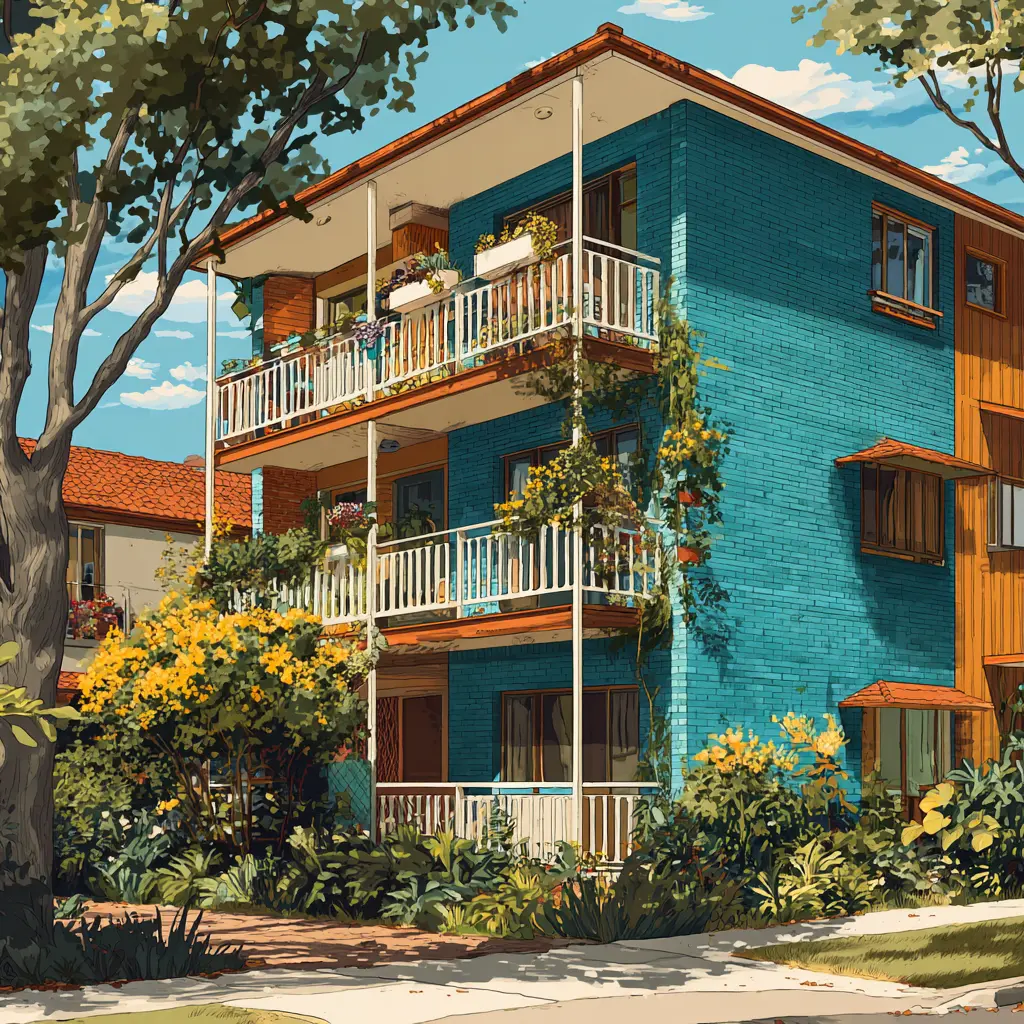
Balconies are common property and they're exposed
Balconies are one of the few parts of a strata building that sit out in the weather year-round, completely unprotected. Sun, rain, and salt all take their toll, and unlike a roof or a fence, a failing balcony can fall on someone. Active inspection isn't optional it's the most important safety duty a Management Committee has.
Who owns the balcony?
Where lots are stacked, the balcony structure is common property and the corporation maintains it, even where an owner has exclusive use of the space on top of it. Where lots are freestanding and sit side by side, the balcony belongs to whoever owns the building it is attached to. The physical arrangement decides it, not the label on your title.
That split holds nationally. The structural distinction matters more here than in almost any other maintenance question, because a balcony slab is usually load-bearing and its waterproofing membrane sits inside the structure rather than on the surface of a lot.
The duty, by jurisdiction
NSW. Strata Schemes Management Act 2015, s 106(1). Note s 107: the common property memorandum deals expressly with balcony surfaces and balustrades, so a scheme that adopted it may have shifted some responsibility to owners.
VIC. Owners Corporations Act 2006, s 46. Lot owners must not repair or alter common property themselves (s 47A).
QLD. Body Corporate and Community Management Act 1997, s 152, with the duty in your regulation module: Standard Module s 180, Accommodation Module s 170, Commercial Module s 127, Small Schemes Module s 99.
WA. Strata Titles Act 1985, s 91(1)(c), which expressly covers deterioration from inherent defect as well as fair wear and tear. Relevant where a membrane was wrong from the day it was laid.
SA. Strata Titles Act 1988, s 25 for strata corporations. Community Titles Act 1996, s 75 where one lot sits above another; where each lot sits side by side, the balcony belongs to the lot owner.
TAS. Strata Titles Act 1998, Schedule 1 clause 8.
ACT. Unit Titles (Management) Act 2011, s 24(1).
NT. Unit Titles Act 1975, s 34(b).
For more on the difference between these title types, see Unit Titles Explained.
How balconies are built
Most balconies fall into one of three structural categories:
Cantilevered balconies: The deck joists run a significant distance back into the building proper, anchoring the balcony to the structure with no posts at the outer edge. Visually clean but heavily reliant on the integrity of the connection points inside the wall.
Post-supported balconies: The outer edge of the balcony rests on vertical posts running back to the building or down to ground footings.
Footing-supported balconies: Variations on the above, with the outer support resting on its own dedicated footings.
Knowing which type you're dealing with matters when something starts to fail, because the failure modes are different.
Common failure modes
Weathering: UV, rain and temperature swings degrade timber and finishes. Repainting and re-sealing on a regular cycle slows this down dramatically.
Timber rot: Fungi develop wherever water settles into joints between two pieces of timber. Most rot starts at connection points, not in the middle of a beam.
Steel corrosion: Bolts, brackets and reinforcing rods rust. Coastal and seaside environments accelerate this enormously.
Concrete spalling: The rebar inside concrete rusts, expands and pushes chunks of concrete off. Once visible from below, the damage is usually well advanced.
Inspecting a timber balcony
Walk through this checklist at least once a year, and after any major storm or unusually wet period:
Identify the timber species: Oregon (Douglas Fir) is unsuitable for external structures. It's a softwood with a broad pink-tinged grain when freshly exposed. If the balcony is built from Oregon, treat it as already at risk.
Look for compression or deformity: In any structural members, sagging, splayed posts or visible bowing are warning signs.
Probe with a screwdriver: Decayed timber feels soft and spongy. Probe at every connection point, every join and every place where two pieces of timber meet.
Get underneath: Use a ladder to inspect connection points at the beams from below. Test the brackets and bolts for rust.
Check the building anchor: Make sure cantilevered joists actually run into the building and that bolted connections are secure.
Inspect post bases. Probe for rot at the base of any timber post. Check that posts are anchored into the ground or into a proper footing, not just bolted to the surface of the paving.
Test handrails and balustrades: They should not be loose, rotting or unstable. A rickety handrail is a fall waiting to happen.
Inspecting a concrete balcony
Look for signs of deflection: If the balcony slopes or leans, there's a structural problem. Use a long spirit level if you're not sure.
Examine the underside: Rust stains on exposed steel reinforcing are a sign of serious internal corrosion.
Check the handrails and balustrades: Same as for timber, they must not be loose, rusting or rotting.
Take spalling seriously: If you can see chunks of concrete flaking off, especially with rebar exposed, get a structural engineer to inspect the whole balcony before it gets worse.
If you're worried about a balcony
If a balcony shows any of the warning signs above and you're not sure whether it's still safe to use, block access immediately. Don't wait for the structural engineer's report. Physically secure the access doors so the balcony can't be used until a structural engineer or building consultant has assessed it and certified it safe.
The financial cost of inconveniencing residents for a fortnight is trivial compared to the cost of a balcony collapse; for the people on it, for the corporation, and for the manager who knew there was a problem and didn't act.
Best practice
Add a balcony walk-through to the corporation's annual maintenance inspection cycle
Repaint timber and re-seal timber decks on a regular schedule before visible deterioration sets in
In coastal locations, accelerate the inspection cycle to twice yearly and use marine-grade fixings on any new work
Engage a structural engineer for any concern about deflection, spalling, exposed rebar or rotted structural members, not a general handyman
Keep the inspection records. They protect the committee and the manager if a defect is later discovered
Get in touch
If you've noticed something concerning about a balcony and your group isn't sure what to do next, get in touch. We can help you arrange a structural assessment and work through the options.
Call us on 1300 79 2255 or email hello@acaciacollective.com.au.
Related Articles


Have questions about strata?
Get in touch and we'll help with your strata needs.