
Stairs - Ownership, Types and What To Watch
Who owns the stairs?
Shared stairs and stairwells are common property. The corporation owns the structure, the surface, the handrails and the lights and is responsible for keeping all of it safe.
Internal stairs entirely within a single unit (a maisonette or two-level townhouse) are the owner's property.
The maintenance duty, by jurisdiction
A shared staircase sits outside the boundary of any single lot and serves more than one, which makes it common property, and the body that owns the common property carries a statutory duty to keep it in repair. That holds across Australia. What changes is the name of the body and the section that imposes the duty.
NSW. Strata Schemes Management Act 2015, s 106(1): the owners corporation must properly maintain the common property and keep it in a state of good and serviceable repair, and must renew or replace fixtures and fittings (s 106(2)). A common property memorandum under s 107 can shift responsibility for specified items onto an owner, so check whether your scheme has adopted one.
VIC. Owners Corporations Act 2006, s 46: the owners corporation must repair and maintain the common property. Lot owners must not repair or alter it themselves (s 47A).
QLD. Body Corporate and Community Management Act 1997, s 152, with the operative duty in whichever regulation module applies to your scheme: Standard Module s 180, Accommodation Module s 170, Commercial Module s 127, Small Schemes Module s 99. Establish your module before quoting a section.
WA. Strata Titles Act 1985, s 91(1)(c): the strata company must keep the common property in good and serviceable repair, properly maintain it, and renew or replace it if necessary, whether the deterioration comes from fair wear and tear, inherent defect or any other cause.
SA. Strata Titles Act 1988, s 25(a) for strata corporations, with s 5 putting structural elements outside unit boundaries in common property. Community Titles Act 1996, ss 28 and 75(1)(b) for community corporations.
TAS. Strata Titles Act 1998, Schedule 1 clause 8: the body corporate must administer, manage and control the common property and maintain the service infrastructure in good and serviceable order.
ACT. Unit Titles (Management) Act 2011, s 24(1): the owners corporation must maintain the common property.
NT. Unit Titles Act 1975, s 34(b): the corporation must keep in good repair and properly maintain the common property.
Stair materials in unit groups
Concrete
Concrete is the most common type in multi-storey groups. It is long-lasting, fire-resistant and structurally simple. However, common faults include spalling at the nosings (where concrete breaks away at the step edges from foot traffic), cracking at landings and rust staining where the reinforcement sits too close to the surface.
Steel
Steel is often used for external fire stairs and some commercial-style buildings. Galvanised steel handles weather well, whereas painted steel rusts at any chip in the coating. The two failure points are the welds and the bearer connections to the building. Both should be checked annually for any external stair.
Timber
Older buildings and some heritage groups use timber for their stairs. Timber is beautiful when maintained but vulnerable to rot, especially at the base of stringers (the diagonal beams supporting the treads) where they sit on or near the slab. Internal timber stairs in protected stairwells last well, whereas external timber stairs are a maintenance commitment.
The six things to watch
1. Tread surfaces
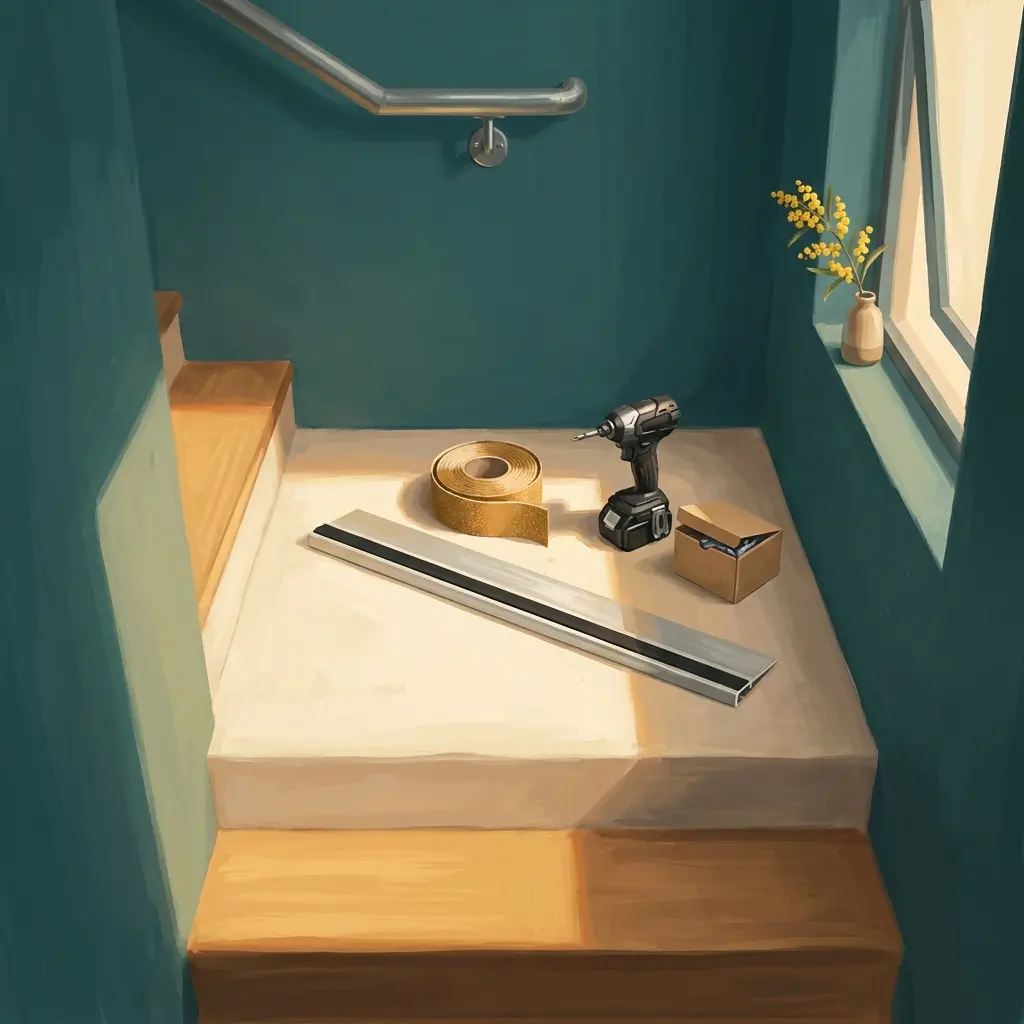
Worn tread surfaces, particularly polished concrete in entries or smooth tiles on stair noses, are slip hazards when wet. Installing anti-slip strips or a textured non-slip coating along the leading edge of each tread is cheap and dramatically reduces falls.
2. Handrails
Handrails should be continuous, securely fixed at intervals no greater than 1.2m and graspable (35–50mm diameter for round rails). Wobbly handrails are common and dangerous, so make sure to check them at every inspection. The Building Code requires handrails on both sides of any stair more than 1m wide.
3. Nosings
The nosings (front edge of each step) should be visually distinct from the tread surface so the edge is easy to see, whether that's through a metal nosing strip or paint. Older concrete stairs often have worn-down nosings that blend with the rest of the tread. A contrasting nosing is one of the most cost-effective safety upgrades.
4. Lighting
Stairwell lighting should be bright enough to see step edges clearly and ideally on a movement sensor so it's on whenever someone is on the stairs. See Maintaining Lighting for the broader picture.
5. Tripping hazards
Lifted edges, loose carpet, frayed runners and broken tiles are all tripping hazards. Any of these on a stair is a public liability claim waiting to happen, so be sure to document and address these hazards promptly.
6. Riser heights
All risers in a flight of stairs (the vertical face between one tread and the next) should be the same height - within ±5mm. Variation throws people's footing as the brain calibrates step height after the first two or three treads. If a flight has a noticeably different riser at the top or bottom (often where a stair meets a landing), consider a contrasting paint stripe or a warning sign at minimum, and a structural rebuild ideally.
Public liability reality
Falls on stairs are one of the most common sources of public liability claims against strata corporations. The defence to a claim is "we maintained the stairs to a reasonable standard", and that defence is much easier to mount when there's a documented inspection rhythm and a record of corrective work. See our article on Insurance.
Inspection rhythm
Implement a monthly walkover by a responsible officer or property manager: check that handrails are secure, nothing loose is underfoot, lighting is working and there is no water damage.
Ensure there is an annual close inspection: check the tread wear, the nosing condition, handrail bracket fixings and structural integrity for steel and timber stairs.
Review against the current Building Code provisions every 5 years, particularly the handrail height, baluster spacing and slip resistance, which would have all tightened over the years.
Get in touch
If your stairs are showing wear and you're weighing repair versus a more substantial upgrade, we're happy to walk through them with you and help you scope the work. Acacia Collective manages strata and community title groups across South Australia.
Call us on 1300 79 2255 or email hello@acaciacollective.com.au.
Related Articles


Have questions about strata?
Get in touch and we'll help with your strata needs.