TV Antennas - Who Owns Them?
Who owns the antenna?
A shared (Master Antenna Television or MATV) system serving multiple units is common property, which means it is owned and maintained by the corporation. An individual antenna serving one unit only is the owner's.
For groups without a shared system, owners typically each have their own roof-mounted aerial. This is workable but messy: 24 antennas on a single roof means each one is a potential leak point, therefore each one is a maintenance liability for somebody.
The maintenance duty, by jurisdiction
A shared antenna system serves more than one lot, which makes it common property, and the corporation carries the statutory duty to maintain it. An individual aerial serving one unit is that owner's. The principle is the same nationally; the section number is not.
NSW. Strata Schemes Management Act 2015, s 106(1), with a s 107 common property memorandum able to shift specified items onto an owner.
VIC. Owners Corporations Act 2006, s 46 for common property and s 47 for services.
QLD. Body Corporate and Community Management Act 1997, s 152, with the duty in your regulation module: Standard Module s 180, Accommodation Module s 170, Commercial Module s 127, Small Schemes Module s 99.
WA. Strata Titles Act 1985, s 91(1)(c).
SA. Strata Titles Act 1988, s 5(6) for cables and equipment not exclusively serving one unit, s 25 for the duty. Community Titles Act 1996, ss 3 and 28 for service infrastructure serving more than one lot, s 75 for the duty.
TAS. Strata Titles Act 1998, Schedule 1 clause 8.
ACT. Unit Titles (Management) Act 2011, s 24(1).
NT. Unit Titles Act 1975, s 34(b).
Two distribution systems
MATV (Master Antenna Television)
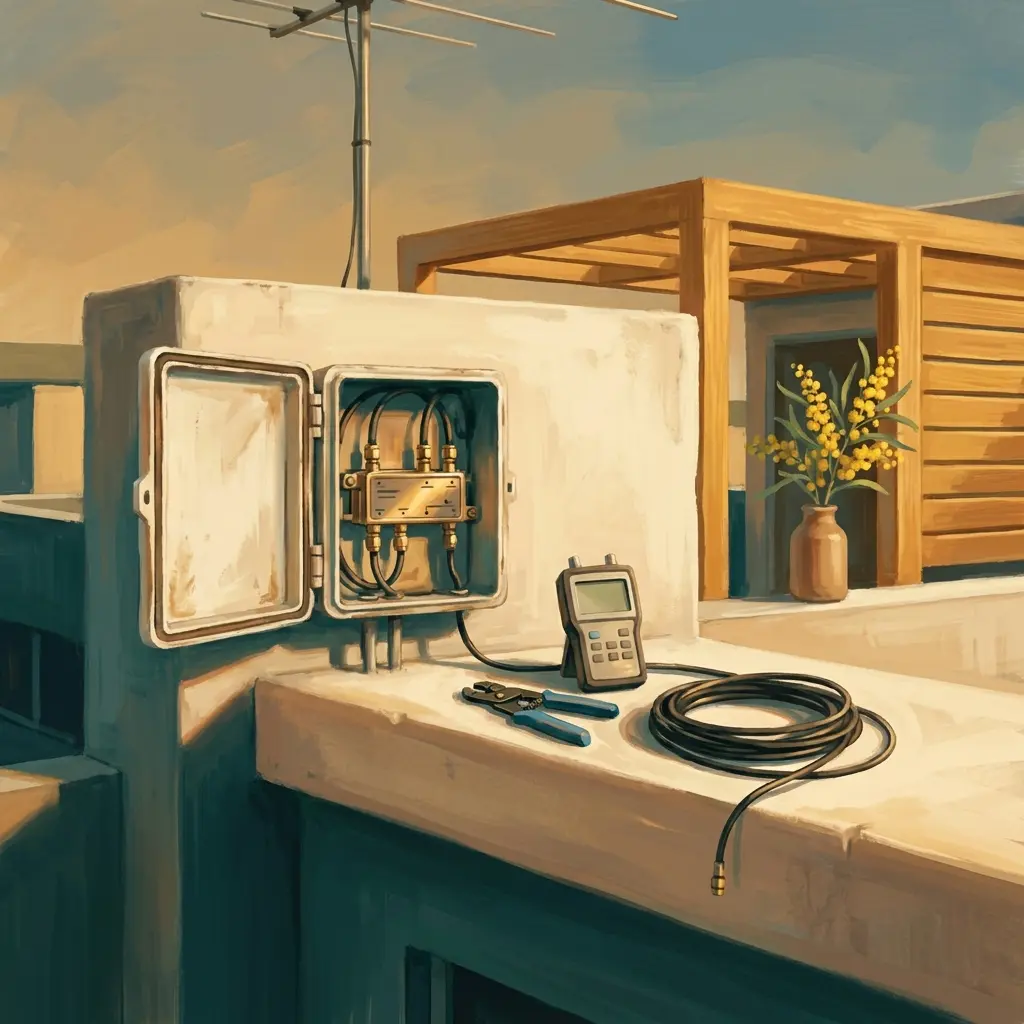
One or more rooftop antennas feed signal through a head-end amplifier and a coaxial-cable distribution network to outlets in each unit. When the owner plugs their TV into the wall outlet, the signal arrives the same way it would from a private aerial.
Pros: clean roofline (no forest of individual antennas), better signal quality than most individual aerials in fringe reception areas and a single maintenance point for the corporation.
Cons: head-end equipment ages and needs eventual replacement as the cable network can develop faults that affect multiple units at once.
Individual antennas
Each unit owner installs and maintains their own rooftop aerial. This is common in older groups that pre-date MATV and in groups where the by-laws never prohibited it.
Pros: each owner controls their own setup so there is no shared infrastructure to maintain.
Cons: roof penetrations multiply (each one a leak risk), antennas at all angles look untidy and storm damage to a 24-antenna roof is a much bigger insurance event than damage to a single shared system.
Common MATV faults
Reception issues at one unit
When only one unit has a problem, it's usually downstream of the head-end, for example a damaged wall plate, a corroded F-connector at the unit's outlet or a faulty TV. Have the owner check their cable and connections first, but an antenna technician's call-out will confirm whether the fault is at the unit end or further upstream.
Reception issues at multiple units
When several units have problems simultaneously, the fault is upstream, either at the head-end amplifier, in a splitter or at the antenna itself. Common causes: water ingress at the antenna mast (corroded balun), failed power supply on the head-end amplifier or even lightning strike damage. An antenna technician will diagnose the issue with a signal meter at each splitter junction.
Storm damage
Simply put, antennas catch wind. After a major storm, check that the antenna is still vertical, that the boom is straight and the cable has not pulled out of the connector at the antenna end. Damage to a shared antenna is usually insurable. See our article on Insurance Claims.
Aging head-end equipment
Distribution amplifiers typically last 10–15 years before they need replacement. Possible symptoms of an ageing amplifier are: a progressive signal degradation across all units, increased noise on weak channels or an occasional total loss requiring a power cycle to recover. When equipment reaches its end-of-life, replacement is often a chance to upgrade to a system that handles current digital broadcast standards more cleanly.
The case for a by-law
If your group has a MATV system and wants to keep the roofline clean, a by-law prohibiting individual rooftop antennas is the right call. Most groups already have one, so check your by-law schedule. If yours doesn't, the committee can propose one for adoption at a general meeting. See our article on By-laws Explained.
Federal Government rules limit how restrictive a by-law can be regarding antennas where reception is genuinely poor, as owners have a right to receive broadcast television. But where the MATV system delivers good reception, a by-law against individual aerials is enforceable and sensible.
Streaming and future-proofing
An increasing number of residents now stream most of their content rather than rely on broadcast TV. This doesn't make the MATV system redundant, as broadcast remains the most reliable way to receive emergency information and free-to-air news, but it does change the case for major upgrades. When the head-end equipment reaches end-of-life, weigh "like-for-like replacement" against "scaled-back system that just covers free-to-air essentials" against "fibre-to-the-unit upgrade as part of a connectivity overhaul".
Inspection rhythm
Annually: complete a visual check of the antenna mast (vertical, secure, cable intact). Bundle that with the pre-winter roof inspection.
After major storms: walk-around to confirm the antenna and cable haven't shifted.
Every 5–7 years: have an antenna technician run a signal-quality check at the head-end and at sample outlets, to catch slow degradation before it becomes a complaint.
Get in touch
If your group has reception complaints across multiple units, or you're weighing a head-end equipment upgrade, we're happy to help you scope the work. Acacia Collective manages strata and community title groups across South Australia.
Call us on 1300 79 2255 or email hello@acaciacollective.com.au.
Related Articles


Have questions about strata?
Get in touch and we'll help with your strata needs.