
Strata and body corporate air conditioning: options and approvals
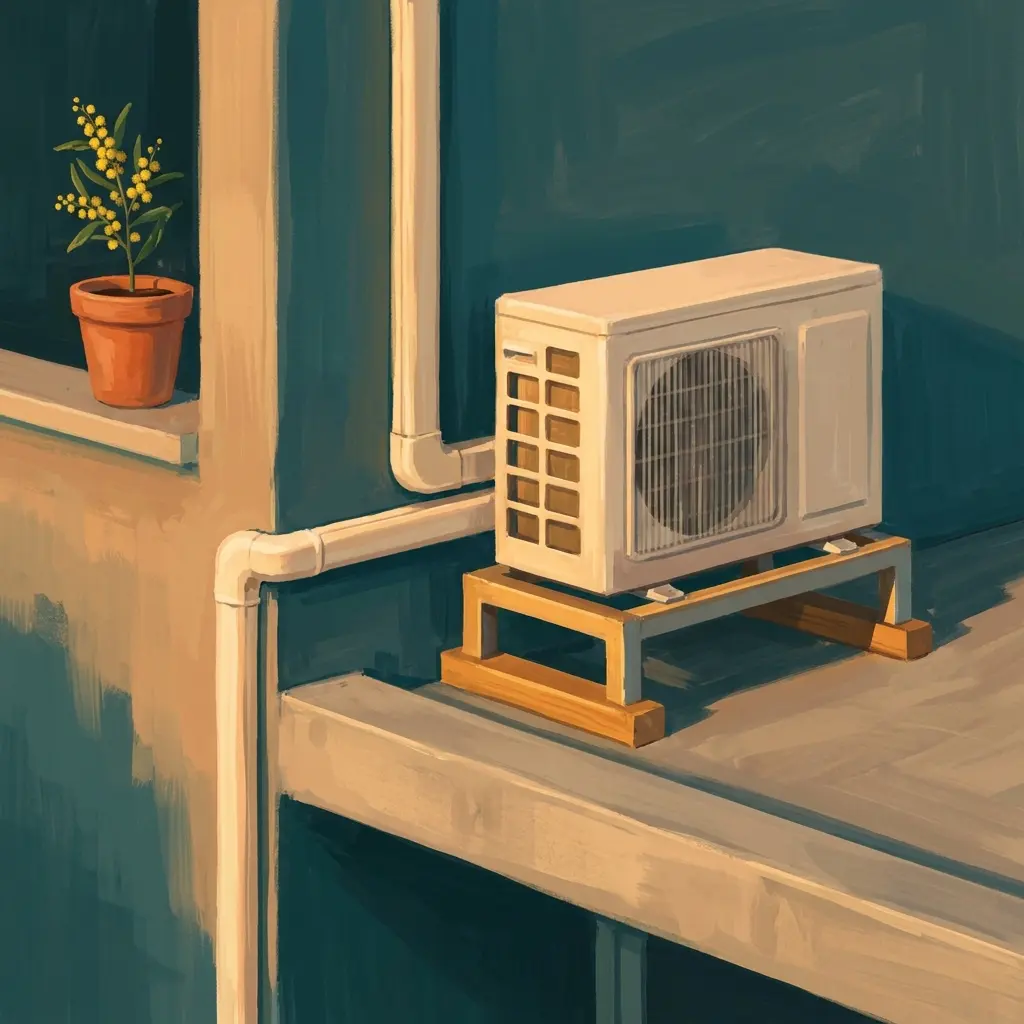
Summer is close, and the first hot week is when the requests arrive: an owner wants a split system in before Christmas, a neighbour wants to know why a compressor appeared on the wall overnight, and the committee wants to know what it is allowed to say yes to. This guide is for owners and committees working through those questions. It covers where the outdoor unit can go, flat roofs in particular, what approval South Australian law requires, and what to do about noise.
If you want the background first (the four main system types, and who owns and maintains each one in every state and territory), start with our guide to air conditioners in strata and community groups.
The short answer
The air conditioner is usually yours. The wall, roof or slab it sits on usually is not.
In a South Australian strata scheme, putting up a structure or changing the outside look of the building needs a special resolution of the corporation. A committee cannot give that approval on its own.
Keeping part of the common property for your own use, such as the patch of roof under a compressor, is a bigger decision and needs a unanimous resolution in strata, or an exclusive use by-law in community title.
Noise is the most common source of disputes after installation, and from 18 June 2027 an installation that causes a noise nuisance can itself be an offence.
Before you buy: three questions
Most air conditioning disputes start with a unit bought before anyone asked where it would go. Three questions, answered first, prevent most of them.
Where will the outdoor unit sit? On an external wall, a balcony, a courtyard, a roof or the ground. Each answer leads to a different approval path.
What will the pipes and cables pass through? A hole through an external wall or a roof penetration is work on common property, even when the unit itself is inside your lot.
How will a technician reach it? A compressor on a roof needs safe access for servicing for as long as it is there. If the only way up is a ladder against a gutter, plan for that now.
Your options, by where the outdoor unit goes
External wall bracket
The most common choice for split systems in older walk-up buildings. In a South Australian strata scheme the boundary of a unit is usually the inner surface of its walls, so the external wall is common property (Strata Titles Act 1988, s 5(5)(a) and (6)). A bracket fixed to it, and the hole for the pipework, are work on common property and change the outside look of the building. Expect to need approval.
Balcony or courtyard floor
Often the easiest place to get approved, because the unit sits on a surface rather than hanging off the facade. Check your strata plan: some balconies and courtyards are part of the unit, others are common property. Even inside your unit, a compressor that can be seen from the street or the common areas may still count as altering the external appearance of the building.
Flat roofs
Flat roofs come up every summer, especially in townhouse groups and low-rise blocks where there is no room on the walls. In strata, a unit's upper boundary is generally the under surface of the ceiling or roof, which makes the roof common property (Strata Titles Act 1988, s 5(5)(c) and (6)). A rooftop installation therefore involves the corporation from the start. A few points matter more on a flat roof than anywhere else:
Waterproofing. Flat roofs rely on their membrane. Every penetration for pipes or cables is a future leak point, and a poorly sealed one can void a roofing warranty. Ask the installer to use the existing penetrations where possible and to say who is responsible for the seal.
Load and fixing. Units should sit on a proper frame or pads that spread the load and keep the unit clear of ponding water, not directly on the membrane. For heavier ducted or evaporative units, the corporation may want an engineer to confirm the roof can carry it.
Drainage. Condensate and evaporative cooler bleed-off water need somewhere to go other than across the roof and into a neighbour's gutter.
Access and appearance. Set the unit back from the edge where practical, so it is less visible from the street and easier to service safely.
Pitched roofs
Roof-mounted evaporative coolers and ducted condensers on pitched roofs raise the same common property questions as flat roofs, plus appearance. Many corporations ask for these to sit below the ridgeline, at the rear, in a colour close to the roof.
No outdoor work at all
If approval is not possible before the heat arrives, a portable unit that vents through a partly opened window involves no building work and usually needs no approval. It is less efficient than a split system, but it can bridge the gap while a proper installation goes through the meeting process.
What approval South Australian law requires
Strata schemes (Strata Titles Act 1988)
Installing the unit. Section 29 says a person must not carry out "prescribed work" in relation to a unit without authority from a special resolution of the strata corporation (or, where every unit is non-residential, under the articles). Prescribed work includes putting up, altering or removing a structure, and altering the external appearance of a building or structure (s 29(6)). A wall-hung compressor, a roof frame or a new penetration through an external wall will usually fall within it. There is a narrow exception for some work in two-unit schemes that has development approval (s 29(1a)).
What a special resolution is. At least 14 days' written notice setting out the terms of the resolution, and a vote at a properly convened meeting where the votes against are 25% or less of all the votes that could be cast if every owner were present (s 3). In a three-unit scheme, the resolution fails if more than one vote is cast against it.
The committee cannot approve it alone. A management committee has no power to do anything that the Act requires a special or unanimous resolution for (s 35(3)). An email from the committee saying "go ahead" does not authorise the work.
Exclusive use of common property. Approving the installation is not the same as giving the owner the right to occupy the part of the common property the unit sits on. The corporation may grant a unit holder an exclusive right to occupy part of the common property for a specified period, but only by unanimous resolution (s 26(4)): a special resolution with no vote against it (s 3).
If the work goes ahead without approval. The corporation can give the owner written notice to remedy any structural damage or restore the unit to its previous state within a reasonable time (s 29(2)).
Community title schemes (Community Titles Act 1996)
Strata-type community schemes (where lots are defined by a building) follow the same rule as strata: prescribed work on a strata lot needs a special resolution of the community corporation, unless every lot is non-residential and the by-laws deal with it (s 102).
Other community schemes, where each lot is land with its own house, are governed mainly by the by-laws. By-laws may regulate the position, design and external appearance of buildings and improvements on lots (s 34(3)). Read them first. If they say nothing about air conditioners or appearance, and the unit and its pipework stay entirely within your lot, approval from the corporation may not be needed. Anything placed on common property is a different matter.
Exclusive use in community title is granted by a by-law that gives the occupier of a lot the exclusive right to use a specified part of the common property (s 36(1)). The corporation needs the written consent of the lot owner to make it (s 36(5)), by-laws are varied by special resolution (s 39(1)), and even with exclusive use, installing a fixture on that area still needs a special resolution (s 36(4)).
Shared systems. Air conditioning plant and ducts that serve more than one lot are "service infrastructure" (s 3) and form part of the common property (s 28(1)(b)). The corporation maintains them, and the Act creates easements for the supply of air-conditioned air through them (s 24(1)(c)).
Setting a standing policy
If your group fields several requests each summer, approving them one meeting at a time is slow for owners and repetitive for the committee. Many corporations instead pass a single special resolution that sets out the conditions on which owners may install a unit, so that a compliant installation does not need its own meeting. Typical conditions cover:
where units may and may not go (for example, not on the street frontage or over a common walkway);
colour and screening, so the outdoor unit blends with the building;
a maximum published sound rating for the outdoor unit, and a requirement to place it away from neighbours' bedroom windows;
a licensed installer, sealed penetrations and plumbed condensate drains;
that the owner owns, insures, maintains and eventually removes the unit, and makes good any damage to common property.
Have the wording checked before the meeting. A standing resolution needs to be clear enough that both owners and the committee can tell whether a given installation is covered. The air conditioner guide linked at the top of this article includes a sample policy you can adapt.
Noise, neighbours and the law change coming in 2027
Compressor noise is the complaint that outlasts the heatwave. A unit that runs all night beside a neighbour's bedroom window will cause friction however well it was approved.
In South Australia, noise from domestic air conditioners is handled by your local council as "local nuisance" under the Local Nuisance and Litter Control Act 2016, not by the EPA. The EPA also notes that nuisance within strata and community title schemes is a matter for the scheme's own management, which is why a clear policy and well-written by-laws matter.
The Act is changing. The Local Nuisance and Litter Control (Miscellaneous) Amendment Act 2025 inserts a new s 19A, which makes it an offence to install an air conditioning unit (or an external light), or have one installed, in a fixed position where its operation results in local nuisance. The maximum penalty is $5,000 for an individual and $10,000 for a body corporate. There are defences, including where the nuisance could not reasonably have been foreseen at installation, or where the person did not choose the position. According to the EPA, this section commences on 18 June 2027, so it applies to installations after that date.
The practical lesson applies now: placement decided at installation is far cheaper to get right than to move later.
Compare published sound ratings before you buy, and choose the quieter model where the unit will sit close to a neighbour.
Keep the outdoor unit away from bedroom windows and out of corners, which reflect sound.
Use anti-vibration mounts, and have loose panels and worn fan bearings fixed promptly.
If a neighbour raises a concern, talk early. Most noise disputes are settled by moving or screening the unit, not by a complaint to council.
A summer checklist for committees
Check whether the corporation already has a standing air conditioning resolution or by-law, and whether it still reflects how owners install units today.
If requests are building up, put a standing resolution on the agenda now. Special resolutions need at least 14 days' notice, so a meeting in late October can have rules in place before December.
Service any shared plant before the first hot week, and clean and refill evaporative coolers on common property.
Walk the roof and walls: look for unapproved units, unsealed penetrations, condensate hoses running down walls, and compressors sitting on paths where people could trip.
Keep a register of approved installations, with the date of approval and any exclusive use granted. It saves arguments when units are sold.
References
Strata Titles Act 1988 (SA), version 9.12.2021: s 3 (special resolution, unanimous resolution), s 5(5) and (6) (unit boundaries, common property), s 26(4) (exclusive right to occupy common property), s 29 (alterations and additions), s 35(3) (limits on committee powers).
Community Titles Act 1996 (SA), version 9.12.2021: s 3 (service infrastructure, special resolution), s 24(1)(c) (service easements), s 28(1)(b) (common property), s 34(3) (by-laws on buildings and appearance), s 36 (exclusive use by-laws), s 39(1) (varying by-laws), s 102 (alterations in strata schemes).
Local Nuisance and Litter Control (Miscellaneous) Amendment Act 2025 (SA), s 7 (inserting s 19A).
Environment Protection Authority SA, Neighbourhood nuisance and noise, for who handles air conditioner noise and the commencement dates of the 2025 amendments.
This article is general information about South Australian law as at October 2026, not legal advice. Your scheme's articles, by-laws and strata or community plan can change how these rules apply. Elsewhere in Australia, the approval rules and resolution thresholds are set by your own state or territory's legislation.
Get in touch
If you are working through an air conditioning request, drafting a standing policy, or fielding a noise complaint, we are happy to help. Acacia Collective works with strata and community corporations across South Australia.
Call us on 1300 79 2255 or email hello@acaciacollective.com.au.
Related Articles



Have questions about strata?
Get in touch and we'll help with your strata needs.